(My) CISSP Notes – Security Architecture and Design

Note: This notes were made using the following books: “CISPP Study Guide” and “CISSP for dummies”.

Security Architecture and Design describes fundamental logical hardware, operating system, and software security components, and how to use those components to design, architect, and evaluate secure computer systems.

Security Architecture and Design is a three-part domain. The first part covers the hardware and software required to have a secure computer system. The second part covers the logical models required to keep the system secure, and the third part covers evaluation models that quantify how secure the system really is.

Secure system design concepts

Layering separates hardware and software functionality into modular tiers. A generic list of security architecture layers is as follows:

1. Hardware

2. Kernel and device drivers

3. Operating System

4. Applications

Abstraction hides unnecessary details from the user. Complexity is the enemy of security: the more complex a process is, the less secure it is.

A security domainis the list of objects a subject is allowed to access. Confidential, Secret, and Top Secret are three security domains used by the U.S. Department of Defense (DoD), for example. With respect to kernels, two domains are user mode and kernel mode.

The ring model is a form of CPU hardware layering that separates and protects domains (such as kernel mode and user mode) from each other. Many CPUs, such as the Intel ×86 family, have four rings, ranging from ring 0 (kernel) to ring 3 (user).

The rings are (theoretically) used as follows:

• Ring 0: Kernel

• Ring 1: Other OS components that do not fit into Ring 0

• Ring 2: Device drivers

• Ring 3: User applications

Processes communicate between the rings via system calls, which allow processes to communicate with the kernel and provide a window between the rings.The ring model also provides abstraction: the nitty-gritty details of saving the file are hidden from the user, who simply presses the “save file” button.  A new mode called hypervisor mode (and informally called “ring 1”) allows virtual guests to operate in ring 0, controlled by the hypervisor one ring “below”.

An open system uses open hardware and standards, using standard components from a variety of vendors. An IBM-compatible PC is an open system.

A closed system uses proprietary hardware or software.

Secure hardware architecture

Secure Hardware Architecture focuses on the physical computer hardware required to have a secure system.

The system unit is the computer’s case: it contains all of the internal electronic computer components, including motherboard, internal disk drives, power supply, etc. The motherboard contains hardware including the CPU, memory slots, firmware, and peripheral slots such as PCI (Peripheral Component Interconnect) slots.

A computer bus, is the primary communication channel on a computer system. Communication between the CPU, memory, and input/output devices such as keyboard, mouse, display, etc., occur via the bus. Some computer designs use two buses: a northbridge and southbridge. The northbridge, also called the Memory Controller Hub (MCH), connects the CPU to RAM and video memory. The southbridge, also called the I/O Controller Hub (ICH), connects input/output (I/O) devices, such as disk, keyboard, mouse, CD drive, USB ports, etc. The northbridge is directly connected to the CPU, and is faster than the southbridge.

The “fetch and execute” (also called “Fetch, Decode, Execute,” or FDX) process actually takes four steps: 1. Fetch Instruction 1 2. Decode Instruction 1 3. Execute Instruction 1 4. Write (save) result 1 These four steps take one clock cycle to complete.

Pipelining combines multiple steps into one combined process, allowing simultaneous fetch, decode, execute, and write steps for different instructions.

An interrupt indicates that an asynchronous event has occurred. CPU interrupts are a form of hardware interrupt that cause the CPU to stop processing its current task, save the state, and begin processing a new request. When the new task is complete, the CPU will complete the prior task.

A processis an executable program and its associated data loaded and running in memory. A parent process may spawn additional child processes called threads. A thread is a light weight process (LWP). Threads are able to share memory, resulting in lower overhead compared to heavy weight processes.

Applications run as processes in memory, comprised of executable code and data. Multitasking allows multiple tasks (heavy weight processes) to run simultaneously on one CPU.

Multiprogramming is multiple programs running simultaneously on one CPU; multitasking is multiple tasks (processes) running simultaneously on one CPU, and multithreading is multiple threads (light weight processes) running simultaneously on one CPU.

Multiprocessing has a fundamental difference from multitasking: it runs multiple processes on multiple CPUs.

A watchdog timer is designed to recover a system by rebooting after critical processes hang or crash. The watchdog timer reboots the system when it reaches zero.

CISC (Complex Instruction Set Computer) and RISC(Reduced Instruction Set Computer) are two forms of CPU design. CISC uses a large set of complex machine language instructions, while RISC uses a reduced set of simpler instructions.

Real (or primary) memory, such as RAM, is directly accessible by the CPU and is used to hold instructions and data for currently executing processes. Secondary memory, such as disk-based memory, is not directly accessible.

Cache memoryis the fastest memory on the system, required to keep up with the CPU as it fetches and executes instructions. The fastest portion of the CPU cache is the register file. The next fastest form of cache memory is Level 1 cache, located on the CPU itself. Finally, Level 2 cache is connected to (but outside) the CPU.

RAM is volatile memory used to hold instructions and data of currently running programs.

Static Random Access Memory (SRAM) is expensive and fast memory.

Dynamic Random Access Memory (DRAM) stores bits in small capacitors (like small batteries), and is slower and cheaper than SRAM.

ROM (Read Only Memory) is nonvolatile: data stored in ROM maintains integrity after loss of power.

Addressing modes are CPU-dependent; commonly supported modes include direct, indirect, register direct, and register indirectDirect mode says “Add X to the value stored in memory location #YYYY.” That location stores the number 7, so the CPU adds X + 7. Indirectstarts the same way: “Add X to the value stored in memory location #YYYY.”  The difference is #YYYY stores another memory location (#ZZZZ). The CPU follows to pointer to #ZZZZ, which holds the value 7, and adds X + 7. Register direct addressing is the same as direct addressing, except it references a CPU cache register. Register indirect is also the same as indirect, except the pointer is stored in a register.

Memory protectionprevents one process from affecting the confidentiality, integrity, or availability of another.

Process isolation is a logical control that attempts to prevent one process from interfering with another. This is a common feature among multiuser operating systems such as Linux, UNIX, or recent Microsoft Windows operating systems.

Hardware segmentation takes process isolation one step further by mapping processes to specific memory locations.

Virtual memory provides virtual address mapping between applications and hardware memory.

Swapping uses virtual memory to copy contents in primary memory (RAM) to or from secondary memory (not directly addressable by the CPU, on disk). Swap space is often a dedicated disk partition that is used to extend the amount of available memory. If the kernel attempts to access a page (a fixed-length block of memory) stored in swap space, a page fault occurs (an error that means the page is not located in RAM), and the page is “swapped” from disk to RAM. The terms “swapping” and “paging” are often used interchangeably, but there is a slight difference: paging copies a block of memory to or from disk, while swapping copies an entire process to or from disk.

Firmware stores small programs that do not change frequently, such as a computer’s BIOS (discussed below), or a router’s operating system and saved configuration. Various types of ROM chips may store firmware, including PROM, EPROM, and EEPROM.

Flash memory (such as USB thumb drives) is a specific type of EEPROM, used for small portable disk drives. The difference is any byte of an EEPROM may be written, while flash drives are written by (larger) sectors. This makes flash memory faster than EEPROMs, but still slower than magnetic disks.

The IBM PC-compatible BIOS(Basic Input Output System) contains code in firmware that is executed when a PC is powered on. It first runs the Power-On Self-Test (POST), which performs basic tests, including verifying the integrity of the BIOS itself, testing the memory, identifying system devices, among other tasks. Once the POST process is complete and successful, it locates the boot sector (for systems which boot off disks), which contains the machine code for the operating system kernel. The kernel then loads and executes, and the operating system boots up.

WORM(Write Once Read Many) Storage can be written to once, and read many times. WORM storage helps assure the integrity of the data it contains: there is some assurance that it has not been (and cannot be) altered, short of destroying the media itself. The most common type of WORM media is CD-R (Compact Disc Recordable) and DVD-R (Digital Versatile Disk Recordable). Note that CD-RW and DVD-RW (Read/Write) are not WORM media.

Techniques used to provide process isolation include virtual memory (discussed in the next section), object encapsulation, and time multiplexing.

Secure operating system and software architecture

Secure Operating System and Software Architecture builds upon the secure hardware described in the previous section, providing a secure interface between hardware and the applications (and users) which access the hardware.

Kernels have two basic designs: monolithic and microkernel. A monolithic kernelis compiled into one static executable and the entire kernel runs in supervisor mode. All functionality required by a monolithic kernel must be precompiled in. Microkernelsare modular kernels. A microkernel is usually smaller and has less native functionality than a typical monolithic kernel (hence the term “micro”), but can add functionality via loadable kernel modules. Microkernels may also run kernel modules in user mode (usually ring 3), instead of supervisor mode.  A core function of the kernel is running the reference monitor, which mediates all access between subjects and objects. It enforces the system’s security policy, such as preventing a normal user from writing to a restricted file, such as the system password file.

Microsoft NTFS (New Technology File System) has the following basic file permissions:

• Read

• Write

• Read and execute

• Modify

• Full control (read, write, execute, modify, and delete)

Setuid is a Linux and UNIX file permission that makes an executable run with the permissions of the file’s owner, and not as the running user. Setgid (set group ID) programs run with the permissions of the file’s group. Setuid programs must be carefully scrutinized for security holes: attackers may attempt to trick the passwd command to alter other files.

Virtualization adds a software layer between an operating system and the underlying computer hardware. This allows multiple “guest” operating systems to run simultaneously on one physical “host” computer. There are two basic virtualization types: transparent virtualization (sometimes called full virtualization) and paravirtualization. Transparent virtualization runs stock operating systems, such as Windows 7 or Ubuntu Linux 9.10, as virtual guests. No changes to the guest OS are required. Paravirtualization runs specially modified operating systems, with modified kernel system calls.

Thin clientsare simpler than normal computer systems, with hard drives, full operating systems, locally installed applications, etc. They rely on central servers, which serve applications and store the associated data.Thin client applications normally run on a system with a full operating system, but use a Web browser as a universal client, providing access to robust applications which are downloaded from the thin client server and run in the client’s browser.

A diskless workstation (also called diskless node) contains CPU, memory, and firmware, but no hard drive. Diskless devices include PCs, routers, embedded devices, and others.

System vulnerabilities, threads and countermeasures

System Threats, Vulnerabilities, and Countermeasures describe security architecture and design vulnerabilities, and the corresponding exploits that may compromise system security.

Emanations are energy that escape an electronic system, and which may be remotely monitored under certain circumstances.

A covert channelis any communication that violates security policy. Two specific types of covert channels are storage channels and timing channels. The opposite of as covert channel is an overt channel: authorized communication that complies with security policy. A storage channel example uses shared storage, such as a temporary directory, to allow two subjects to signal each other. A covert timing channel relies on the system clock to infer sensitive information.

Buffer overflows can occur when a programmer fails to perform bounds checking.

Time of Check/Time of Use (TOCTOU) attacks are also called race conditions: an attacker attempts to alter a condition after it has been checked by the operating system, but before it is used. The term race condition comes from the idea of two events or signals that are racing to influence an activity.

A backdoor is a shortcut in a system that allows a user to bypass security checks (such as username/password authentication) to log in.

Malicious Code or Malware is the generic term for any type of software that attacks an application or system.

  • Zero-day exploits are malicious code (a threat) for which there is no vendor-supplied patch (meaning there is an unpatched vulnerability). Zero-day exploits are malicious code (a threat) for which there is no vendor-supplied patch (meaning there is an unpatched vulnerability).
  •  A rootkitis malware which replaces portions of the kernel and/or operating system. A user-mode rootkit operates in ring 3 on most systems, replacing operating system components in “userland.” Commonly rootkitted binaries include the ls or ps commands on Linux/UNIX systems, or dir or tasklist on Microsoft Windows systems. A kernel-mode rootkit replaces the kernel, or loads malicious loadable kernel modules. Kernel-mode rootkits operate in ring 0 on most operating systems.
  • A logic bomb is a malicious program that is triggered when a logical condition is met.
  • Packers provide runtime compression of executables. The original exe is compressed, and a small executable decompresser is prepended to the exe. Upon execution, the decompresser unpacks the compressed executable machine code and runs it.

Server-side attacks

Server-side attacks (also called service-side attacks) are launched directly from an attacker (the client) to a listening service. Server-side attacks exploit vulnerabilities in installed services.

Client-side attacks

Client-side attacks occur when a user downloads malicious content. The flow of data is reversed compared to server-side attacks: client-side attacks initiate from the victim who downloads content from the attacker.

Security Assertion Markup Language (SAML) is an XML-based framework for exchanging security information, including authentication data.

Polyinstantiation allows two different objects to have the same name. The name is based on the Latin roots for multiple (poly) and instances (instantiation).

Database polyinstantiation means two rows may have the same primary key, but different data (!!!????).

Inference and aggregation occur when a user is able to use lower level access to learn restricted information.

Inference requires deduction: clues are available, and a user makes a logical deduction.

Aggregation is similar to inference, but there is a key difference: no deduction is required.

Security Countermeasures

The primary countermeasure to mitigate the attacks described in the previous section is defense in depth: multiple overlapping controls spanning across multiple domains, which enhance and support each other.

System hardening , systems configured according to the following concepts:

  • remove all unnecessary components.
  • remove all unnecessary accounts.
  • close all unnecessary network listening ports.
  • change all default passwords to complex, difficult to guess passwords
  • all necessary programs should be run at the lowest possible privilege.
  • security patches should be install as soon as they are available.

Heterogenous environment  The advantage of heterogenous environment is its variety of systems; for one thing, the various types of systems probably won’t possess common vulnerabilities, which makes them harder to attack.

System resilience The resilience of a system is a measure of its ability to keep running, even under less-than-ideal conditions.

Security models

Security models help us to understand sometimes-complex security mechanisms in information systems. Security models illustrate simple concepts that we can use when analyzing an existing system or designing a new one.

The concepts of reading down and writing upapply to Mandatory Access Control models such as Bell-LaPadula. Reading down occurs when a subject reads an object at a lower sensitivity level, such as a top secret subject reading a secret object. There are instances when a subject has information and passes that information up to an object, which has higher sensitivity than the subject has permission to access. This is called “writing up” because the subject does not see any other information contained within the object. The only difference between reading up and writing down is the direction that information is being passed.

Access Control Models

  • A state machine model is a mathematical model that groups all possible system occurrences, called states. Every possible state of a system is evaluated, showing all possible interactions between subjects and objects. If every state is proven to be secure, the system is proven to be secure.
  • The Bell-LaPadula model was originally developed for the U.S. Department of Defense. It is focused on maintaining the confidentiality of objects.Bell-LaPadula operates by observing two rules: the Simple Security Property and the * Security PropertyThe Simple security property states that there is “no read up:” a subject at a specific classification level cannot read an object at a higher classification level. The * Security Property is “no write down:”a subject at a higher classification level cannot write to a lower classification level. Bell-LaPadula also defines 2 additional properties that will dictate how the system will issue security labels for objects.  The Strong Tranquility Propertystates that security labels will not change while the system is operating.The Weak Tranquility Property states that security labels will not change in a way that conflicts with defined security properties.
  • Take-Grant systems specify the rights that a subject can transfer to a from another subject or object. These rights are defined through four basic operations: create, revoke, take and grant.
  • Biba integrity model (sometimes referred as Bell-LaPadula upside down) was the first formal integrity model.  Biba is the model of choice when integrity protection is vital. The Biba model has two primary rules: the Simple Integrity Axiom and the * Integrity Axiom. The Simple Integrity Axiom is “no read down:”a subject at a specific classification level cannot read data at a lower classification. This protects integrity by preventing bad information from moving up from lower integrity levels.The * Integrity Axiom is “no write up:”a subject at a specific classification level cannot write to data at a higher classification. This protects integrity by preventing bad information from moving up to higher integrity levels.

Biba takes the Bell-LaPadula rules and reverses them, showing how confidentiality and integrity are often at odds. If you understand Bell LaPadula (no read up; no write down), you can extrapolate Biba by reversing the rules: no read down; no write up.

  • Clark-Wilson is a real-world integrity model (this is an informal model) that protects integrity by requiring subjects to access objects via programs. Because the programs have specific limitations to what they can and cannot do to objects, Clark-Wilson effectively limits the capabilities of the subject.Clark-Wilson uses two primary concepts to ensure that security policy is enforced; well-formed transactions and Separation of Duties.
  • The Chinese Wall model is designed to avoid conflicts of interest by prohibiting one person, such as a consultant, from accessing multiple conflict of interest categories (CoIs). The Chinese Wall model requires that CoIs be identified so that once a consultant gains access to one CoI, they cannot read or write to an opposing CoI.
  • The noninterference model ensures that data at different security domains remain separate from one another.

Evaluation methods, certification and accreditation

Evaluation criteria provide a standard for qualifying the security of a computer system or network. These criteria include the Trusted Computer System Evaluation Criteria (TCSEC), Trusted Network Interpretation (TNI), European Information Technology Security Evaluation Criteria (ITSEC) and the Common Criteria.

 Trusted Computer System Evaluation Criteria (TCSEC)

TCSEC commonly known as the Orange Book and it’s the formal implementation of the Bell-LPadula model. The evaluation criteria were developed to achieve the following objectives:

  • Measurement Provides a metric for assessing comparative levels of trust between different computer systems.
  • Guidance Identifies standard security requirements that vendors must build into systems to achieve a given trust level.
  • Acquisition Provides customers a standard for specifying acquisition requirements and identifying systems that meet those requirements.

The Orange Book was the first significant attempt to define differing levels of security and access control implementation within an IT system.

The Orange Book defines four major hierarchical classes of security protection and numbered subclasses (higher numbers indicate higher security) :

  • D: Minimal protection
  • C: Discretionary protection (C1 and C2)
  • B: Mandatory protection (B1, B2 and B3)
  • A: Verified protection (A1)

Trusted Network Interpretation (TNI)

TNI adresses confidentiality and integrity in trusted computer/communications network systems. Within the Rainbow Series, it’s known as the Red Book.

European Information Technology Security Evaluation Criteria (ITSEC)

ITSEC addresses confidentiality, integrity and availability, as well as evaluating an entire system defined as Target of Evaluation (TOE), rather than a single computing platform.

ITSEC evaluates functionality (F, how well the system works) and assurance (E the ability to evaluate the security of  a system).   Assurance correctness ratings range from E0 to E6.

The equivalent ITSEC/TCSEC ratings are:

  • E0:D
  • F-C1,E1:C1
  • F-C2,E2:C2
  • F-B1,E3:B1
  • F-B2,E4:B2
  • F-B3,E5:B3
  • F-B3,E6:A1

Common criteria

The International Common Criteria is an internationally agreed upon standard for describing and testing the security of IT products. It is designed to avoid requirements beyond current state of the art and presents a hierarchy of requirements for a range of classifications and systems.

The common criteria defines eight evaluation assurance levels (EALs): EAL0 through EAL7 in order of increasing level of trust.

System Certification and Accreditation

System certification is a formal methodology for comprehensive testing and documentation of information system security safeguards, both technical and non-technical, in a given environment by using established evaluation criteria (the TCSEC).

Accreditation is an official, written approval for the operation of a specific system in a specific environment, as documented in the certification report.
(My) CISSP Notes – Information Security Governance and Risk Management

Note: This notes were made using the following books: “CISPP Study Guide” and “CISSP for dummies”.
The Information Security Governance and Risk Management domain focuses on risk analysis and mitigation. This domain also details security governance, or the organizational structure required for a successful information security program.

CIA triad

  •  Confidentiality seeks to prevent the unauthorized disclosure of information. In other words, confidentiality seeks to prevent unauthorized read access to data.
  • Integrity seeks to prevent unauthorized modification of information. In other words, integrity seeks to prevent unauthorized write.
  • Availability ensures that information is available when needed.

The CIA triad may also be described by its opposite: Disclosure, Alteration, and Destruction (DAD).

The term “AAA” is often used, describing cornerstone concepts Authentication, Authorization, and Accountability.

  • Authorization describes the actions you can perform on a system once you have identified and authenticated.
  • Accountability holds users accountable for their actions. This is typically done by logging and analyzing audit data
  • Nonrepudiation means a user cannot deny (repudiate) having performed a transaction. It combines authentication and integrity: nonrepudiation authenticates the identity of a user who performs a transaction, and ensures the integrity of that transaction. You must have both authentication and integrity to have nonrepudiation.

Least privilege means users should be granted the minimum amount of access (authorization) required to do their jobs, but no more.

Need to know is more granular than least privilege: the user must need to know that specific piece of information before accessing it.

Defense-in-Depth (also called layered defenses) applies multiple safeguards (also called controls: measures taken to reduce risk) to protect an asset.

Risk analysis

  • Assets are valuable resources you are trying to protect.
  • A threat is a potentially harmful occurrence, like an earthquake, a power outage, or a network-based worm. A threat is a negative action that may harm a system.
  • A vulnerability is a weakness that allows a threat to cause harm.

Risk = Threat × Vulnerability

To have risk, a threat must connect to a vulnerability.

The “Risk = Threat × Vulnerability” equation sometimes uses an added variable called impact: “Risk = Threat × Vulnerability × Impact.

Impact is the severity of the damage, sometimes expressed in dollars.

Loss of human life has near-infinite impact on the exam. When calculating risk using the “Risk = Threat × Vulnerability × Impact” formula, any risk involving loss of human life is extremely high, and must be mitigated.

The Annualized Loss Expectancy (ALE) calculation allows you to determine the annual cost of a loss due to a risk. Once calculated, ALE allows you to make informed decisions to mitigate the risk.

The Asset value (AV) is the value of the asset you are trying to protect.

PIIPersonally Identifiable Information

The Exposure Factor (EF) is the percentage of value an asset lost due to an incident.

The Single Loss Expectancy (SLE) is the cost of a single loss. SLE  = AV x EF.

The Annual Rate of Occurrence (ARO) is the number of losses you suffer per year.

The Annualized Loss Expectancy (ALE) is your yearly cost due to a risk. It is calculated by multiplying the Single Loss Expectancy (SLE) times the Annual Rate of Occurrence (ARO).

The Total Cost of Ownership (TCO) is the total cost of a mitigating safeguard. TCO combines upfront costs (often a one-time capital expense) plus annual cost of maintenance, including staff hours, vendor maintenance fees, software subscriptions, etc.

The Return on Investment (ROI) is the amount of money saved by implementing a safeguard.

Risk Choices

Once we have assessed risk, we must decide what to do. Options include accepting the risk, mitigating or eliminating the risk, transferring the risk, and avoiding the risk.

Quantitative and Qualitative Risk Analysis are two methods for analyzing risk. Quantitative Risk Analysis uses hard metrics, such as dollars. Qualitative Risk Analysis uses simple approximate values. Quantitative is more objective; qualitative is more subjective.

The risk management process

Risk Management Guide for Information Technology Systems (see http://csrc.nist.gov/publications/nistpubs/800-30/sp800-30.pdf).

The guide describes a 9-step Risk Analysis process:

1. System Characterization – System characterization describes the scope of the risk management effort and the systems that will be analyzed.

2. Threat Identification –

Threat Identification and Vulnerability Identification, identify the threats and vulnerabilities, required to identify risks using the “Risk = Threat × Vulnerability” formula.

3. Vulnerability Identification

4. Control Analysis – Control Analysis, analyzes the security controls (safeguards) that are in place or planned to mitigate risk.

5. Likelihood Determination

6. Impact Analysis

7. Risk Determination

8. Control Recommendations

9. Results Documentation

Information Security Governance

Information Security Governance is information security at the organizational level.

Security Policy and related documents

  • Policies are high-level management directives. Policy is high level: it does not delve into specifics. All policy should contain these basic components: Purpose, Scope, Responsibilities , Compliance.  NIST Special Publication 800-12 (see http://csrc.nist.gov/publications/nistpubs/800-12/800-12-html/chapter5.html) discusses three specific policy types: program policy, issue-specific policy, and system-specific policy. Program policy establishes an organization’s information security program.
  • A procedure is a step-by-step guide for accomplishing a task. They are low level and specific. Like policies, procedures are mandatory.
  • A standard describes the specific use of technology, often applied to hardware and software. Standards are mandatory. They lower the Total Cost of Ownership of a safeguard. Standards also support disaster recovery.
  • Guidelines are recommendations (which are discretionary).
  • Baselines are uniform ways of implementing a safeguard.

Roles and responsibilities

Primary information security roles include senior management, data owner, custodian, and user.

  • Senior Managementcreates the information security program and ensures that is properly staffed, funded, and has organizational priority. It is responsible for ensuring that all organizational assets are protected.
  • The Data Owner (also called information owner or business owner) is a management employee responsible for ensuring that specific data is protected. Data owners determine data sensitivity labels and the frequency of data backup. The Data Owner (capital “O”) is responsible for ensuring that data is protected. A user who “owns” data (lower case “o”) has read/write access to objects.
  • A Custodian provides hands-on protection of assets such as data. They perform data backups and restoration, patch systems, configure antivirus software, etc. The Custodians follow detailed orders; they do not make critical decisions on how data is protected.
  • Users must follow the rules: they must comply with mandatory policies procedures, standards, etc.

Complying with laws and regulations is a top information security management priority: both in the real world and on the exam.

The exam will hold you to a very high standard in regard to compliance with laws and regulations. We are not expected to know the law as well as a lawyer, but we are expected to know when to call a lawyer.

The most legally correct answer is often the best for the exam.

Privacy is the protection of the confidentiality of personal information.

Due care and Due Diligence

Due care is doing what a reasonable person would do. It is sometimes called the “prudent man” rule. The term derives from “duty of care”: parents have a duty to care for their children, for example. Due diligence is the management of due care.

Due care is informal; due diligence follows a process.

Gross negligence is the opposite of due care. It is a legally important concept. If you suffer loss of PII, but can demonstrate due care in protecting the PII, you are on legally stronger ground, for example.

Auditing and Control Frameworks

Auditing means verifying compliance to a security control framework (or published specification).

A number of control frameworks are available to assist auditing Risk Analysis. Some, such as PCI (Payment Card Industry), are industry-specific (vendors who use credit cards in the example). Others, such as OCTAVE, ISO 17799/27002, and COBIT.

OCTAVE stands for Operationally Critical Threat, Asset, and Vulnerability Evaluation, a risk management framework from Carnegie Mellon University. OCTAVE describes a three-phase process for managing risk. Phase 1 identifies staff knowledge, assets, and threats. Phase 2 identifies vulnerabilities and evaluates safeguards. Phase 3 conducts the Risk Analysis and develops the risk mitigation strategy. OCTAVE is a high-quality free resource which may be downloaded from: http://www.cert.org/octave/ ISO 17799 and the ISO 27000 Series.

ISO 17799 had 11 areas, focusing on specific information security controls:

1. Policy

2. Organization of information security

3. Asset management

4. Human resources security

5. Physical and environmental security

6. Communications and operations management

7. Access control

8. Information systems acquisition, development, and maintenance

9. Information security incident management

10. Business continuity management

11. Compliance3 ISO 17799 was renumbered to ISO 27002 in 2005, to make it consistent with the 27000 series of ISO security standards.

Simply put, ISO 27002 describes information security best practices (Techniques), and ISO 27001 describes a process for auditing (requirements) those best practices.

COBIT (Control Objectives for Information and related Technology) is a control framework for employing information security governance best practices within an organization.  COBIT was developed by ISACA (Information Systems Audit and Control Association.

ITIL(Information Technology Infrastructure Library) is a framework for providing best services in IT Service Management (ITSM). ITIL contains five “Service Management Practices—Core Guidance” publications: • Service Strategy • Service Design • Service Transition • Service Operation • Continual Service Improvement

Certification and Accreditation

Certification is a detailed inspection that verifies whether a system meets the documented security requirements.

Accreditation is the Data Owner’s acceptance of the risk represented by that system.

Web Application Firewall (WAF) – l’etat de l’art (4)

Produits et solutions

Solutions non-commerciales

ModSecurity – www.modsecurity.org

Le pare-feu applicatif Web le plus utilisé est ModSecurity qui est un projet open-source. ModSecurity est actuellement maintenu par TrustWave, une société qui vend également des pare-feu applicatifs Web commerciaux. ModSecurity
utilise généralement un modèle de sécurité négative et a également plusieurs projets connexes qui contribuent à améliorer la solution. ModSecurity Apache est un module pour le serveur web Apache. ModeSecurity Core Rules est un ensemble de règles permettant de déceler les attaques Web les plus courants. Les ModeSecurity Core Rules sont un excellent point de départ pour ceux qui sont novices en configuration du ModSecurity.

Microsoft URLScan – http://www.iis.net/download/urlscan

UrlScan est un outil de sécurité produit par Microsoft qui limite les types de requêtes HTTP qui Microsoft Internet Information Services (IIS) est capable a traiter. En bloquant des requêtes HTTP spécifiques, l’outil de sécurité UrlScan empêche les requêtes potentiellement dangereuses d’atteindre le serveur. UrlScan est implémenté comme un filtre ISAPI (Internet Server Application Programming Interface) qui analyse les requêtes HTTP reçus par IIS. Lorsqu’il est correctement configuré, UrlScan est efficace a réduire l’exposition des Services aux attaques Internet.

Solutions commerciales

Barracuda Networks – http://www.barracudanetworks.com

Barracuda Networks, les plus connus pour leurs pare-feu SPAM, sont entrées dans le monde des firewall applicatifs par l’acquisition de la société NetContinum.

La société vend ses produits comme applicances et possède actuellement deux lignes de produits, le pare-feu applicatif Web et le contrôleur d’applications Web. Le produit pare-feu est orienté vers des PME avec des unités qui ont un débit entre 25 et 100 Mbps. Le contrôleur d’applications Web est un type de produits orienté vers les grands clients. Prix d’un boitier pare-feu commence à 5 500$.

TrustWave – www.trustwave.com

TrustWave offre deux gammes d’appliances, WebDefend et ModSecurity Pro. ModSecurity Pro est basée sur le projet ModSecurity avec des règles de filtrage complémentaires. WebDefend est un produit qui peut être installé dans l’infrastructure réseaux du client ou comme un service externe offert par TrustWave.

Deny All – www.denyall.com

Deny All et leur produit rWeb est une autre option dans l’espace des pare-feu applicatifs Web. Le produit rWeb utilise un modèle de sécurité positive (white list). Le produit offre également des services de cache de compression et d’équilibrage de charge.

F5 – www.f5.com

F5 vend un pare-feu applicatif Web comme un module complémentaire pour sa ligne des produits BigIP Application Delivery Controllers ou comme une appliance autonome.

Le module WAF utilise un modèle de sécurité positive pour la définition des politiques de sécurité et est livré avec toutes les fonctionnalités que sont attendus d’un WAF prêts pour les entreprises. Une des caractéristiques les plus intéressantes est l’intégration avec WhiteHat Sentinel Vulnerability Assessment Service qui peut automatiquement créer des règles basés sur les vulnérabilités trouvées à partir d’un scan Sentinel WhiteHat. Le WAF autonome est vendu autour de 28.000$, tandis que le prix des solutions BigIP commence autour de 65.000$.

Imperva – www.imperva.com

Le pare-feu applicatif  SecureSphere d’Imperva est l’un des appareils plus réputés du marché. Selon Gartner, Imperva “apparaît le plus souvent sur la liste des produits préférées par les clients de Gartner.» (Young, 2008)

Imperva, utilise ce que la société appelle «l’inspection transparente”, une technologie pour combiner la sécurité avec la haute performance.

Les politiques de sécurité sont basées sur un modèle de sécurité positive et Imperva a également des options pour le suivi de base de données de vulnérabilités. Les prix commencent à 35.000 $.

Pour une liste contenant d’autres solutions consultez le site de OWASP : https://www.owasp.org/index.php/Web_Application_Firewall

Bibliographie (pour le 4 posts concernant les Waf)

[OWASP] https://www.owasp.org

[MISC 60] http://www.ed-diamond.com/produit.php?ref=misc60

[MISC 57] http://www.ed-diamond.com/produit.php?ref=misc57

[WASC] http://www.webappsec.org/

[WAFEC] http://projects.webappsec.org/w/page/13246985/Web%20Application%20Firewall%20Evaluation%20Criteria

[WAFBook] http://dl.acm.org/citation.cfm?id=1512788

Web Application Firewall (WAF) – l’etat de l’art (3)

Les contre-mesures offerts par un pare-feu applicatif

Protection contre les dénis de service

Cette protection est assez délicate à mettre en œuvre du fait de la variété des méthodes utilisées pour générer un déni de service. Il existe deux types de solutions.

La première se base sur un contrôle comportemental. Différents paramètres sont surveillés : nombre des requêtes par seconde (par utilisateur ou au global), temps de réponse des serveurs, etc. Et des seuils de dépassement sont configurées (ex : augmentation de 200% de temps de réponse moyen d’un serveur). Lorsque ces seuils sont dépassées, des contre-mesures sont mises en place : limitation du nombre de requêtes par seconde, blacklisting de certains sources des requêtes.

Une autre protection utilise des mécanismes de détection des bots ou vers. Pa exemple, un Javascript est injecté dans chaque réponse émise par le serveur. Si le client répond au Javascript, nous avons a faire à un browser (pas forcement honnête), dans l’autre cas, nous avons affaire à un script de génération de requête et nous allons pouvoir d’ores et déjà restreindre son activité ou dérouter son trafic soit en le bloquant soit en le l’envoyant ailleurs (ex : honeypot pour récupérer plus d’informations sur l’attaquant).

Protection contre les élévations de privilèges

Il est possible de protéger une application de cette attaque via des « white-lists » : des règles spécifiant quel contenu doit être accédé sur l’application. Toute requête ne respectant pas ces règles sera rejeté. Il est possible de définir ces contenus selon différents critères :

  • Type d’objets : php, aspx,html, css, js, etc. Toutes les requêtes à destination des objets de types conf, sh, dll, exr, pl,… seront bloquées.
  • URL : seules les requêtes a destination du chemin «/public/ » (par exemple) sont autorisées et ainsi les requêtes sur les path « /conf/ », « /logs/ », « /admin/ », « /root/ »,… seront bloquées.
  • Objets : dans ce cas les objets ne sont plus définis par leur type mais de manière unitaire : index.php, home.asp,… Cette méthode est plus précise, mais plus complexe à maintenir, bien que des outils de découverte et d’apprentissage des applications puissent faciliter l’exploitation.

Protection contre l’injection du code

Pour se protéger contre l’injection du code et spécialement de l’injection du code SQL, plusieurs méthodes peuvent être utilisées et combinées :

  • Mise en place de signature d’attaques : bien qu’il existe une infinité de combinaisons pour procéder à une injection SQL, certaines sont connues et peuvent être facilement identifiées à l’aide d’une expression régulière. Tout contenu de la requête (en général les données d’un POST HTTP) matchant la signature provoquera le blocage de la requête.
  • Inspection des données envoyées à l’application : les injections étant très souvent véhiculées par un POST http ou dans un URL, il est intéressant de soumettre ces données à un contrôle des caractères envoyées. En effet, les injections SQL nécessitent souvent l’emploi de caractères de type «= », « ” », «-», … Une règle bloquant ces caractères dans les formulaires de saisie ou dans certains paramètres permettent de se prémunir contre ces attaques.

Protection contre les Cross-site Scripting

De la même manière que pur sécuriser une application contre les injections SQL, il est possible d’implémenter des règles de contrôle de données envoyées a travers un POST http ou dans les paramètres en interdisant des caractères de type « < », « > », « / », …

Protection contre les vols de sessions  HTTP

Les attaques utilisant un vol de cookie peuvent être contrées de plusieurs manières qui peuvent être combinées pour obtenir le meilleur niveau de sécurité :

  • Chiffrement SSL : le chiffrement permet d’éviter (en tout cas de compliquer) le vol de cookies par un sniffer sur un réseau local. En effet, même si le trafic est capturé, les données ne seront pas exploitables. Une variante consiste à ne chiffrer que le contenu du cookie qui devient ainsi inexploitable. Si le serveur ne possède pas cette capacité, le WAF peut réaliser cette opération en chiffrant le contenu du cookie lors de son envoi vers le client et en le déchiffrant avant de l’envoyer au serveur.
  • Protection contre les attaques XSS : un des moyens les plus utilisés pour voler un cookie est de procéder à une attaque XSS.

Comment choisir son pare-feu applicatif web

Le « Web Application Security Consortium » (WASC) est une organisation a but non lucratif constitué des industriels et des représentants des organisations qui produisent des logiciels libres qui a comme but a faire connaître les meilleures pratiques concernant la sécurité du web.

Parmi les projets menés par WAFEC il y a :

  • The Web Hacking Incidents Database (WHID) : projet dédié au maintien d’une liste d’incidents liées a la sécurité des applications web.
  • The Web Application Security Scanner Evaluation Criteria (WASSEC) : est un ensemble de lignes directrices pour évaluer des scanners pour des application web.
  • The Script Mapping Project : Le but du projet est de fournir avec une liste exhaustive des vecteurs pour exécuter des scripts dans une page web sans l’utilisation de la balise <script>.
  • Web Security Glossary : Le projet est un index alphabétique des termes et la terminologie relatives à la sécurité des applications Web. Le but de ce glossaire est de clarifier davantage le langage utilisé au sein de la communauté

Concernant les WAFs, WASC mène le projet WAFEC (The Web Application Firewall Evaluation Criteria). Le but de ce projet est de développer une analyse détaillée des critères d’évaluation des WAF et la mise en place d’une méthodologie de test qui peut être utilisé par n’importe quel technicien raisonnablement compétent pour évaluer indépendamment la qualité d’une solution WAF.

Le WAFEC sert deux objectifs : d’une part il aide les utilisateurs à comprendre ce qu’est un WAF est quel et son rôle dans la protection des sites web et d’autre part, WAFEC fournit un outil pour les utilisateurs à prendre une décision éclairée lorsque ils choisissent un WAF.

La première version de WAFEC été publié en 2006 et est la première ressource qui a fourni la définition d’un WAF. WAFEC est couramment utilisé par des organisations lors de l’évaluation d’un WAF.

Le WAFEC contiens les critères suivants :

  • L’architecture de déploiement : cette section met en évidence les questions clé pour déterminer la faisabilité du déploiement de pare-feu d’applications Web dans un environnement donné.
  • Le support HTTP et HTML : cette section énumère les versions du protocole HTTP et HTML qui doivent être supportées par les WAF.
  • Les techniques de détection : section contenant les technique de détection possibles, model de sécurité positif, model de sécurité négatif, model de sécurité basé sur les signatures.
  • Les techniques  protection : cette section énumère les exigences spécifiques pour la protection qui ne sont pas couvert en utilisant des mécanismes de protection génériques décrites dans d’autres sections.
  • La journalisation : cette section énumère les exigences spécifiques pour la journalisation des évènements générés par le WAF, le format de logs (text, XML, API), comment les administrateurs peuvent être notifiés (email, SMTP Trap, API).
  • Les rapports générés par le WAF : section contant des informations sur le rapports génères par le WAF, le format du rapport (HTML, XML, PDF), les mécanismes de distribution des rapports (email, FTP).
  • Le management : section contenant les critères pour manager le WAF, l’habilité d’accepter manuellement les faux positives, l’habilité de appliquer des politiques par application, l’habilité de customiser les signatures d’attaques.
  • La performance : sections contenant des informations sur la performance au niveau HTTP, la niveau HTTPS (SSL), la performance sur
  • Les services web : les caractéristiques des WAFs concernant les services web, est-ce que le WAF protège des services web, est-ce que le WAF valide les appelles a des services web.

Web Application Firewall (WAF) – l’etat de l’art (2)

L’architecture d’un pare-feu applicatif web

Le placement du pare-feu applicatif web

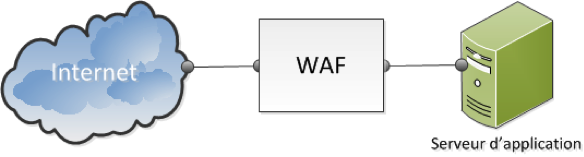
Les pare-feu applicatifs qui sont des appliances sont d’habitude placés directement derrière un pare-feu classique et avant les serveurs Web de l’organisation. Habituellement le positionnement du pare-feu applicatif fait que tout le trafic web passe à travers celui-ci. Pourtant, certaines solutions peuvent être positionnées sur un port de surveillance du réseau (network monitoring port) et donc elles reçoivent une copie du trafic réseau.

Les pare-feu applicatifs qui sont intégrées directement dans les serveurs web fournissent des fonctionnalités similaires en traitant le trafic avant qu’il n’atteigne l’application web.

Le modèle de sécurité

Un pare-feu applicatif suit généralement soit un modèle de sécurité positive ou négative quand il s’agit de l’élaboration de politiques de sécurité pour les applications Web.

Le modèle de sécurité négatif autorise par défaut toutes les transactions. Seules les transactions contenant des attaques sont rejetées. Basé sur une signature, le pare-feu applicatif détecte les attaques en exécutant des correspondances de définitions. Et, comme c’est le cas avec les logiciels antivirus et les systèmes de prévention des intrusions (IPS), la vitesse, la qualité et la quantité de mises à jour des signatures publiées par le fournisseur sont cruciaux.

Pour ce qui est du modèle de sécurité positif, le pare-feu applicatif refusera toutes les transactions par défaut et s’appuiera sur les ensembles de règles pour autoriser les seules transactions réputées fiables. Cette méthode exigera du firewall une activité d’apprentissage non négligeable pour détecter les transactions légitimes. Pour le WAF fonctionnant de la sorte, il est important de savoir s’il prendra en charge les mises à jour automatiques pour son modèle de comportement applicatif, sans devoir le former à nouveau lors de chaque mise à jour. En outre, il convient de s’intéresser aux techniques de normalisation qu’il utilise afin que des pirates ne puissent pas esquiver votre firewall en modifiant tout simplement une charge utile malveillante afin qu’elle semble inoffensive.

Le modes de fonctionnement

Les pare-feu applicatifs web peuvent fonctionner dans plusieurs modes distincts.
Chaque mode offre divers avantages et inconvénients qui obligent les organisations à évaluer la place optimale du WAF dans l’infrastructure réseau.

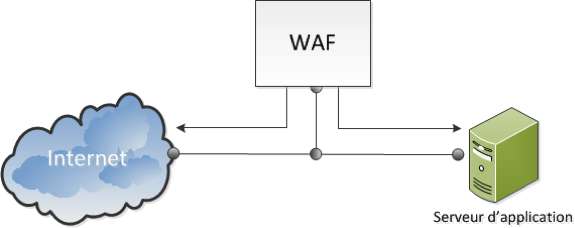
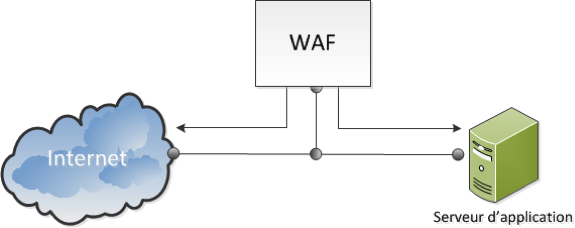
Le mode passif

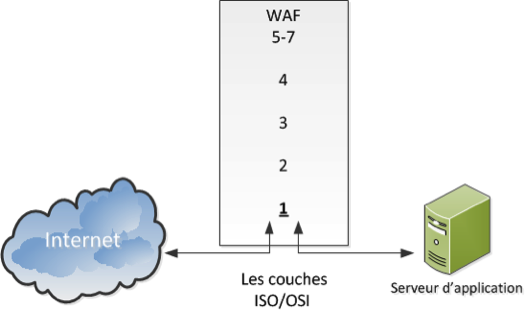
Dans le mode passif, le WAF écoute le trafic sur un port de control (n’est pas en ligne directe avec le trafic) et donc n’est pas capable de l’influencer. Ce mode est idéal pour tester le WAF dans l’environnement sans nuire au trafic. Le trafic est répliqué au niveau 1 (couche physique) de la couche ISO/OSI.

Le mode de fonctionnement passif

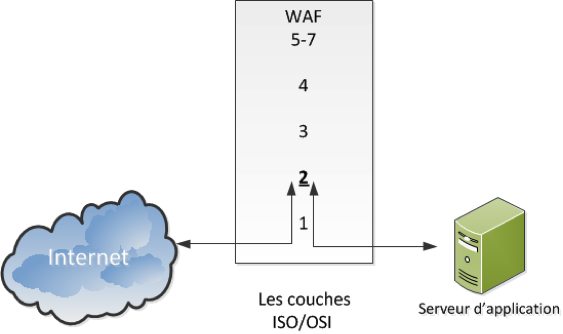
Le mode bridge

Le mode bridge est similaire au mode passif. Le WAF fonctionne comme un switch au niveau 2 (couche liaison de données) de la couche ISO/OSI. Ce mode offre des performances élevées et pas des changements importants au niveau de l’infrastructure réseau puisque le WAF n’as même pas besoin d’une adresse IP. Ce mode a quelques inconvénients ; il n’est pas possible de fournir des services de cache.

Le mode de fonctionnement bridge

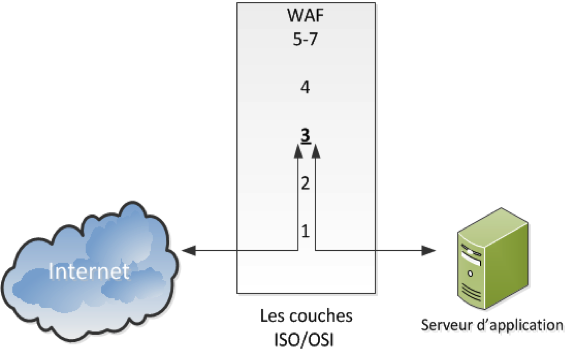
Le mode routeur

A WAF en mode routeur agit comme un routeur au niveau 3 (couche réseau) de la couche ISO/OSI donc le WAF est en ligne directe avec le trafic Internet. C’est possible en ce mode de remplacer directement un router existant même si ce n’est pas conseillé.

Le mode de fonctionnement router

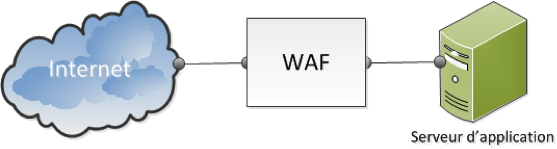
Le mode reverse-proxy

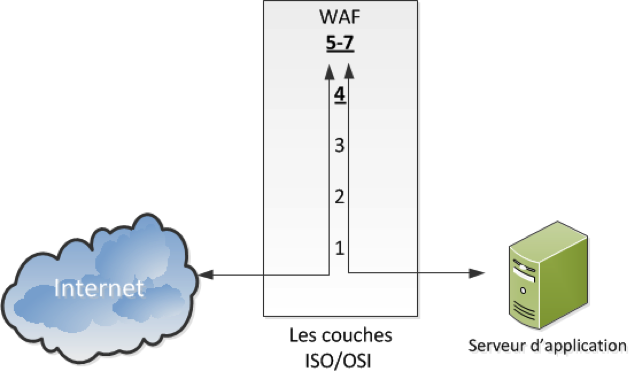
Le mode reverse-proxy est le déploiement le plus courant et riche en fonctionnalités. En ce mode, le WAF se trouve en ligne directe avec le trafic venant de l’Internet. Le WAF a une adresse IP publique et toutes les requêtes concernant les applications web lui y sont directement adressées. Le WAF ensuite fait la requête au serveur web au nom du navigateur d’origine. L’inconvénient d’un mode reverse proxy est qu’il peut augmenter la latence des applications web.

Le mode de fonctionnement reverse-proxy

Le mode embarqué

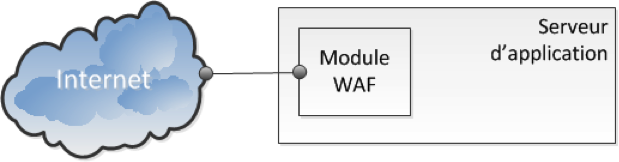
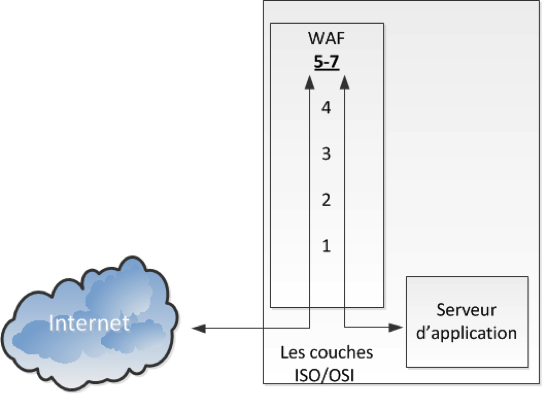
Dans ce mode le WAF est embarqué dans le serveur web comme un module logiciel. Cette approche a certains avantages pour le déploiement des applications web de complexité réduite parce que aucun matériel supplémentaire n’est nécessaire. Pourtant, pour des raisons de scalabilité c’est recommandé d’installer le WAF sur un serveur web indépendant.

Le mode de fonctionnement embarqué